If you buy through our links, Amazon pays us a small commission at no extra cost to you. It never affects our scores. How we are funded.
If you are shopping for a helmet you will see ECE 22.06 everywhere. If you already own one, it is probably 22.05. What changed, and do you need to replace it?
How to check your helmet’s approval
Look at the label sewn onto the chin strap. You will see a capital E in a circle followed by a number (the country that approved it) and a code starting with 05 or 06. That number tells you whether it is 22.05 or 22.06.
What ECE 22.06 adds
22.06 is considerably tougher than 22.05:
- More impact points on the shell, instead of a few fixed ones.
- Impacts at several speeds, not just one, to check the helmet protects in both hard and softer knocks, which are the most common.
- Oblique impact test: it measures the rotation of the head in an angled impact, which is linked to serious brain injuries.
- Tougher visors, tested against high-speed impacts.
- Accessories sold by the helmet maker, such as some intercoms, are taken into account.
Is a 22.05 helmet still legal in the UK?
Yes. UK law accepts helmets approved to ECE 22.05 or 22.06, or to British Standard BS 6658:1985 with the Kitemark. A 22.05 helmet in good condition remains road legal. We explain the full rules in is my motorcycle helmet road legal in the UK?
That said, if your 22.05 helmet has more than five years of use or has taken a knock, it is time to replace it, and a new helmet should be 22.06.
When buying, go for 22.06
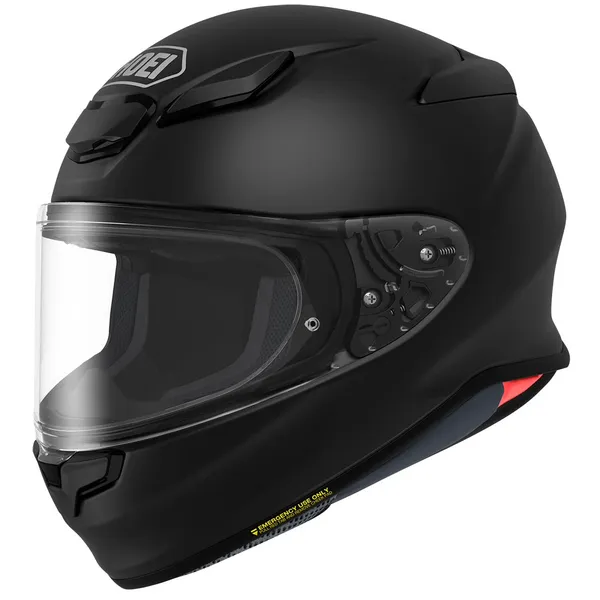
There is no reason to settle for 22.05 on a new helmet. You can find 22.06 helmets at every price point:
Beware of bargains
A heavily discounted 22.05 helmet can be tempting, but it is a design that no longer passes current tests. For the price difference, an entry-level 22.06 is the better buy.
More in our full-face helmet guide.