If you buy through our links, Amazon pays us a small commission at no extra cost to you. It never affects our scores. How we are funded.
They are two of the most recommended premium full-face helmets, both ECE 22.06 approved (road legal in the UK) and both made in four shell sizes. And yet their philosophies are very different.
Head to head
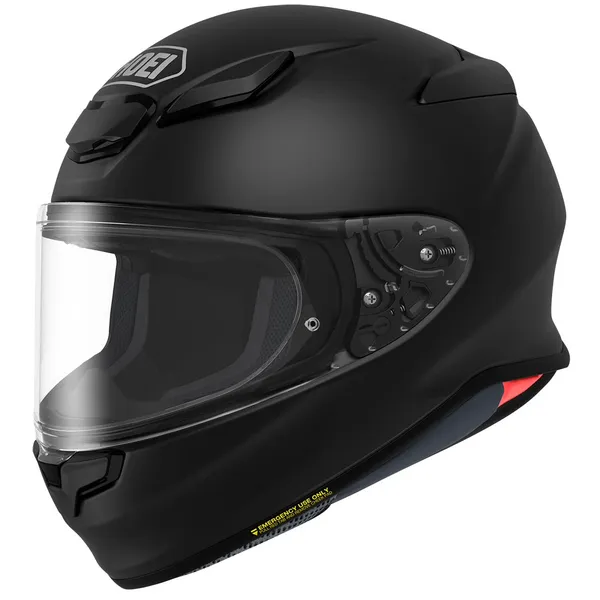
| Spec | Shoei NXR2 | HJC RPHA 71 |
|---|---|---|
| Overall score | 8.7 | 8.6 |
| Safety | 9.2 | 9.0 |
| Comfort | 9.0 | 8.8 |
| Quietness | 8.3 | 8.6 |
| Ventilation | 8.7 | 8.2 |
| Value | 7.2 | 8.2 |
| Weight | 1,390 g | 1,567 g |
| Approval | ECE 22.06 | ECE 22.06 |
| Shell sizes | 4 | 4 |
| Shell material | Multi-composite fibre (AIM) | Composite fibre PIM+ (carbon, glass and aramid) |
| Internal sun visor | No | Yes |
| Pinlock anti-fog | EVO included | Included |
| Fastening | Micrometric ratchet | Double D-ring |
| Sizes | XS to XXL | XS to XXL |
Highlighted in orange: the winner of each measurable spec. Manufacturer data.
Weight: Shoei wins
The NXR2 weighs around 1,390 g according to Shoei; the RPHA 71, around 1,570 g according to HJC. That is almost 180 g, and on a long motorway ride you feel it in your neck.
Sun visor: HJC wins
This is the big difference. The RPHA 71 has an internal sun visor with three positions. The NXR2 does not: Shoei leaves it out to save weight and keep the shell compact. If you often ride into a low sun, it weighs heavily in the decision.
Fastening
The HJC uses a double D-ring, the racing standard. The Shoei uses a micrometric ratchet, quicker to do up with gloves.
Anti-fog
Both come with a Pinlock insert included; in the Shoei’s case a Pinlock EVO.
Value: HJC wins
The RPHA 71 offers more features and is usually cheaper than the NXR2. The Shoei, in return, has a fit and finish many consider the benchmark.
Verdict
More options in our full-face helmet guide.