If you buy through our links, Amazon pays us a small commission at no extra cost to you. It never affects our scores. How we are funded.
If you are buying a helmet in the UK, you will see SHARP stars in shops, reviews and adverts. They are one of the most useful tools you have, as long as you know what they measure and what they do not.
What SHARP is
SHARP (Safety Helmet Assessment and Rating Programme) is a consumer information scheme set up by the Department for Transport in 2007. It is not a legal requirement: every helmet sold for UK roads must already meet a legal standard such as ECE 22.05 or 22.06. SHARP goes further and tells you how much protection a helmet offers compared with others.
How helmets are tested
According to SHARP, each model goes through:
- 32 impact tests: 30 linear and 2 oblique impacts.
- A minimum of 7 helmet samples, in a range of sizes.
- Three impact speeds: 6, 7.5 and 8.5 metres per second. The top speed is higher than the one used for ECE 22.05 (7.5 m/s) and ECE 22.06 (8.2 m/s).
- Different anvils: flat, kerb-shaped and an abrasive surface for the oblique tests.
- Impacts at several points: crown, front, rear and sides.
SHARP only tests full-face and system (flip-front) helmets. Open-face helmets are not rated.
What the stars mean
- Ratings go from 1 star (lowest) to 5 stars (highest).
- Each extra star means better protection across the whole helmet, not just in one spot.
- On the SHARP website, each helmet also has a colour map showing how well it protects in each area: green (low risk), amber and red (high risk).
The latch score for flip-front helmets
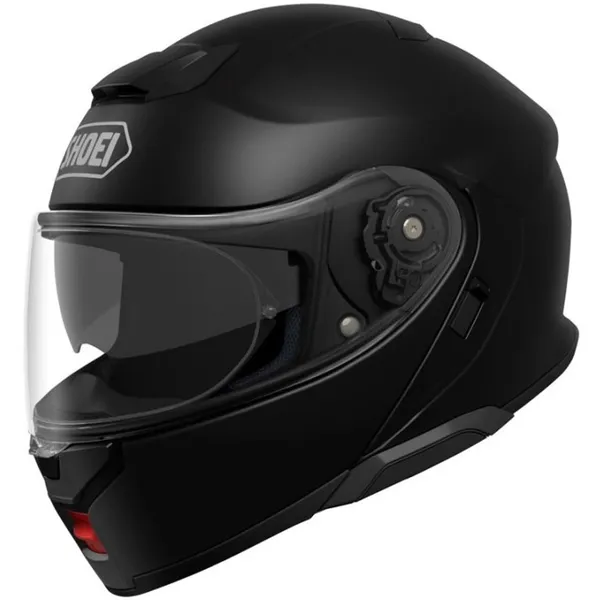
For system helmets, SHARP adds a latch percentage: how often the chin bar stayed fully locked during the 30 linear impacts. 100 % means it never opened. A chin bar that opens in a crash offers no face protection, so look for 100 % when you buy a modular.
How to use SHARP when buying
- Check the exact model and generation. A rating for an older version does not carry over to a new one.
- Use it to compare helmets you already like, not as the only criterion. A 5-star helmet that does not fit you properly protects less than a 4-star one that does. Fit comes first: see how a full-face helmet should fit.
- Not rated does not mean unsafe. New models take time to be tested, and SHARP cannot test everything on the market.
- Look up the rating on the official site (sharp.dft.gov.uk), not only in adverts.
Helmets in our comparison
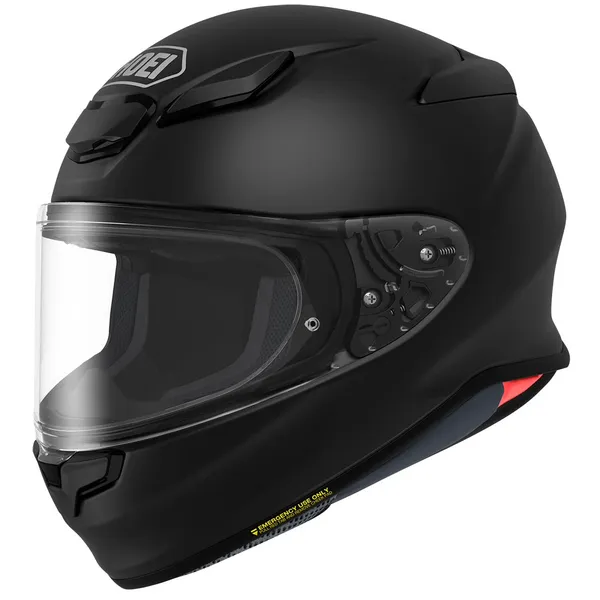
We always recommend checking the current SHARP rating of any helmet you are considering on the official website. These are the helmets we rate most highly in our own comparison:
You can compare all of them in our full-face helmet guide and learn what UK law requires in is my motorcycle helmet legal in the UK?