If you buy through our links, Amazon pays us a small commission at no extra cost to you. It never affects our scores. How we are funded.
Both have 1/1.3-inch sensors, both shine in low light and both are among the best action cameras around. But each one bets on something different.
Head to head
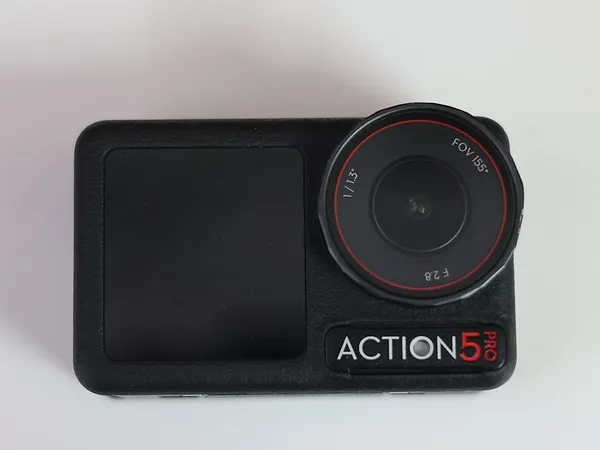
| Spec | Insta360 Ace Pro 2 | DJI Osmo Action 5 Pro |
|---|---|---|
| Overall score | 8.5 | 8.6 |
| Image | 9.2 | 8.8 |
| Stabilisation | 8.8 | 9.0 |
| Battery | 8.8 | 9.5 |
| Ease of use | 8.2 | 8.6 |
| Value | 8.2 | 8.6 |
| Type | Action | Action |
| Max resolution | 8K at 30 fps | 4K at 120 fps |
| Max stated battery life | 180 min | 240 min |
| Waterproof without case | 12 m | 20 m |
| Weight | 178 g | 146 g |
| Stand-out feature | Leica lens and a 1/1.3-inch sensor | Dual touchscreens and a 1/1.3-inch sensor |
Highlighted in orange: the winner of each measurable spec. Manufacturer data.
Image: advantage Insta360
The Ace Pro 2 records up to 8K at 30 fps, against 4K at 120 fps for the DJI, and its lens is co-engineered with Leica. If you want maximum detail and room to work in the edit, the Insta360 is a step ahead.
Battery: advantage DJI
DJI claims up to 240 minutes; Insta360, up to 180 minutes. Both are ideal-condition figures, but the gap holds in real use.
Water and weight: advantage DJI
- DJI: waterproof to 20 m, 146 g.
- Insta360: waterproof to 12 m, around 178 g.
On a bike, less weight on the helmet means less vibration and less leverage.
Screen: advantage Insta360 for vlogging
The Ace Pro 2 has a flip screen, very handy for framing yourself when you talk to camera. The DJI uses a fixed dual screen, also useful to see yourself.
Verdict
More in our motorcycle camera guide.