If you buy through our links, Amazon pays us a small commission at no extra cost to you. It never affects our scores. How we are funded.
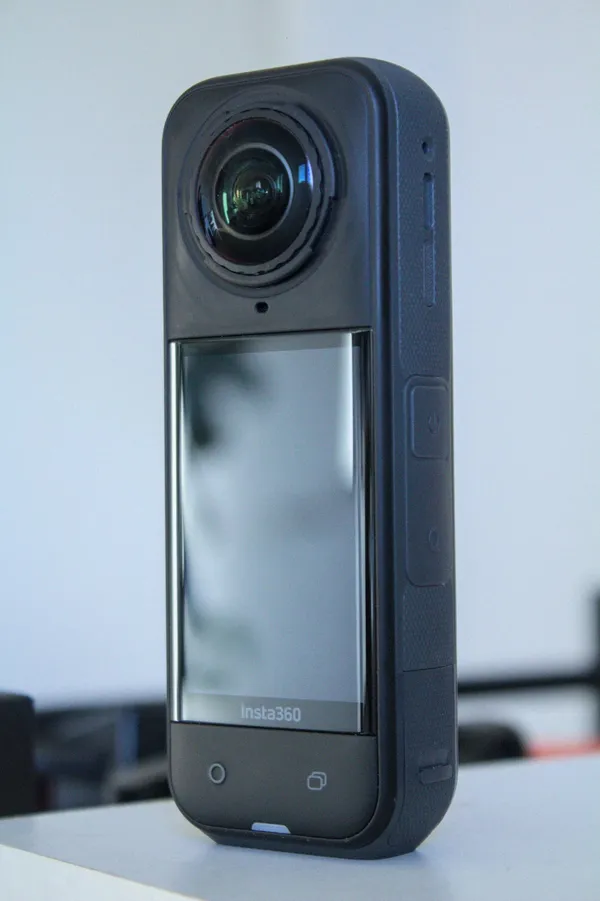
For years, a 360 camera for riding meant an Insta360. The DJI Osmo 360 took it on, and its second generation, the Osmo 360 II (September 2026), raises the bar. We compare them with riding in mind.
Head to head
| Spec | Insta360 X5 | DJI Osmo 360 II |
|---|---|---|
| Overall score | 8.7 | 8.5 |
| Image | 8.8 | 9.2 |
| Stabilisation | 9.5 | 9.2 |
| Battery | 7.8 | 8.2 |
| Ease of use | 8.0 | 8.2 |
| Value | 8.0 | 7.8 |
| Type | 360° | 360° |
| Max resolution | 8K at 30 fps | 8K at 60 fps |
| Max stated battery life | 185 min | 100 min |
| Waterproof without case | 15 m | 10 m |
| Weight | 200 g | 183 g |
| Stand-out feature | Invisible selfie stick and replaceable lenses | 105 GB built-in storage and replaceable lenses |
Highlighted in orange: the winner of each measurable spec. Manufacturer data.
Image: DJI has the edge
The X5 records 360 video in 8K at 30 fps with 1/1.28-inch sensors. The Osmo 360 II reaches 8K at 60 fps with HDR, uses a square 1-inch sensor and claims 14.5 stops of dynamic range. On a bike you notice it in two ways: motion is smoother and it copes better with tunnels and backlight.
Battery: very close in 8K
- DJI Osmo 360 II: up to 100 minutes in 8K at 30 fps.
- Insta360 X5: up to 88 minutes in 8K and up to 185 in 5.7K endurance mode.
Toughness, weight and storage
The X5 is waterproof to 15 m and weighs 200 g. The Osmo 360 II, to 10 m and 183 g. Both now have replaceable lenses: if one gets scratched you can swap it without sending the camera away. The DJI adds 105 GB of built-in storage; the X5 records to microSD.
Motorcycle accessories: Insta360 wins
This is the practical difference. Insta360 has been making motorcycle accessories for years, with its invisible selfie stick and dedicated handlebar mounts that create the “drone” shot. DJI’s range is smaller.